Cultures on opposite ends of the world reached for the same knobby root to calm swollen joints, centuries before anyone knew what a gingerol was.
Key takeaways
- A 2025 randomized trial found a fermented ginger extract improved pain perception, functional capacity, and inflammation markers in adults with mild to moderate joint pain.
- Ginger contains over 400 bioactive compounds, including gingerols, shogaols, and paradols, thought to drive its anti-inflammatory and pain-relieving effects.
- Traditional systems across Asia, the Middle East, and Europe independently used ginger, usually the dried root, for joint pain caused by "cold" or damp conditions.
- Ginger can interact with blood thinners, metformin, and other substances, so people on medication should check with a doctor first.
- Evidence is still limited to a small number of human trials, so ginger should be seen as a supportive tool, not a replacement for medical treatment.
Long before anyone measured an inflammatory marker in a blood sample, people in China, Korea, Japan, India, the Middle East, and England independently pointed to the same root for the same problem: joints that ached, swelled, and stiffened, especially when the weather turned cold and damp. That's a strange kind of consensus to arrive at with no shared data, no journals, no way to compare notes across continents. It suggests something in the root itself was doing real work—work modern science is only now starting to name.
What it is and how it works
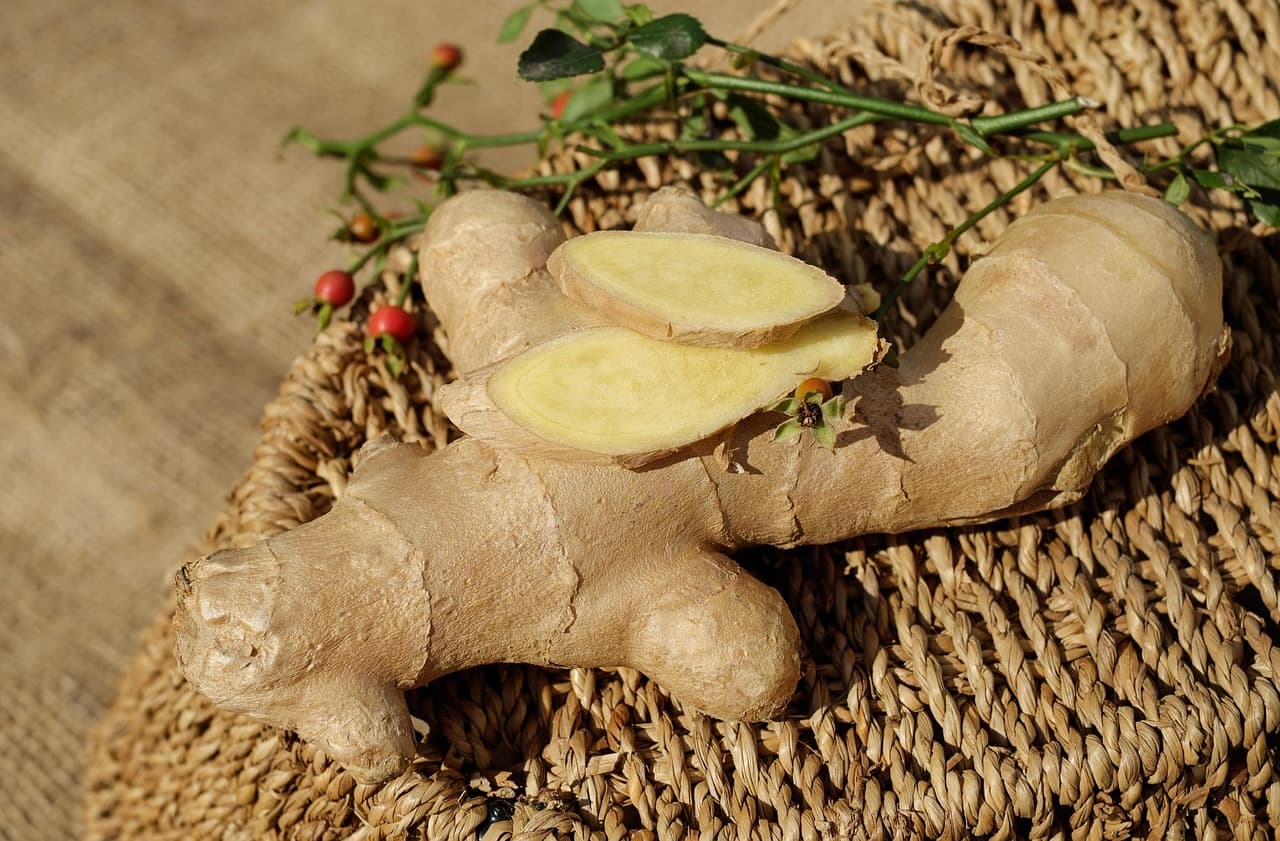
Ginger, the rhizome of Zingiber officinale, isn't a single active ingredient but a chemical cocktail. Researchers have isolated over 400 bioactive compounds from it, including gingerols, shogaols, paradols, gingerdiones, and various terpenes, many of which show anti-inflammatory properties and appear to inhibit pain receptors in laboratory and clinical research1. Because of this profile, ginger has been marketed as a natural analgesic, a pain reliever that works through calming inflammatory signaling rather than blocking pain the way a typical over-the-counter drug does.
Is this for you?
Why are you considering ginger for inflammation?
This is not medical advice — just general orientation.
What the research shows
The strongest human evidence in our review comes from a 2025 randomized, placebo-controlled, parallel-arm trial2. Thirty men and women, averaging 56 years old, with a history of mild to moderate joint and muscle pain, took a specialized ginger extract produced through supercritical CO₂ extraction and fermentation. Researchers drew fasting blood, had participants rate pain under standardized pressure on the thigh, and put them through weighted squats and deep knee bends to test functional capacity. The trial tracked changes in inflammation markers alongside pain and movement scores, directly testing whether ginger does what tradition long claimed: ease joint pain and support movement.
Beyond that single trial, a broader 2021 review of ginger's pharmacology1 catalogs the sheer range of documented activity—anti-inflammatory, analgesic, anti-diabetic, and anti-obesity effects among them—attributed mainly to 6-gingerol, gingerdiol, gingerol, gingerdione, paradols, shogaols, sesquiterpenes, and zingerone. This is a wide net, and it's worth being honest about what it means: most of ginger's traditional reputation, from nausea to fertility to rheumatism, is backed by a mix of mechanistic and observational evidence rather than large, repeated human trials on any single use. The joint-pain trial above is a genuine and welcome exception, but it is one trial with 30 participants, not a body of confirmed proof.
Traditional perspective
Ayurveda
India · over 3,000 years
In Ayurveda, joint pain starts not at the joint but in a sluggish digestive fire that leaves behind āma, a toxic residue that lodges in the body and causes āmavāta11. Dried ginger, śuṇṭhī, is used specifically to rekindle that digestive fire, clear kapha, and calm vāta, typically combined into formulas like Śuṇṭhī-Guggulu rather than used alone. Ayurveda's own pharmacopoeia distinguishes dried ginger from fresh ginger (ārdraka) for this purpose, and the classical text Bhāvaprakāśa Nighaṇṭu even named the dried root āmavātaghnī, "destroyer of āmavāta"12.
What the science says
PartialA 2025 randomized trial shows ginger extract can ease joint pain and improve movement2, supporting the joint-relief outcome Ayurveda has long attached to dried ginger, though the āma-and-digestive-fire explanation behind it sits outside what modern trials measure.
TCM
China · over 2,000 years
Nearly two thousand years ago, the Jin Gui Yao Lue described lì jié, swelling and stiffness in the joints, as the forerunner of what TCM calls painful obstruction, bì zhèng3. Its remedy, Gui Zhi Shao Yao Zhi Mu Tang, still used today for rheumatoid arthritis, gives fresh ginger the largest single dose of any herb in the formula, though as a supporting player that helps the warming herbs chase wind, cold, and damp from the channels. A separate formula for a low back that feels "heavy and cold, as though sitting in water"4 gives dried ginger the heaviest dose among its four herbs, promising that once it takes effect, "the lumbus then becomes warm."
What the science says
PartialModern research doesn't test TCM's cold-and-damp framework directly, but a 2025 human trial does show ginger extract can improve joint pain and function2, lending some support to the effect these formulas describe even though the traditional explanation of why differs from today's inflammation-marker language.
Japanese Kampo
Japan · since the 7th century
In Kampo, ginger, called shōkyō, appears in Keishikajutsubuto, a formula composed by physician Tōdō Yoshimasu and recorded in the Hōki5. Practitioners reach for it when joint pain and neuralgia flare alongside coldness and swelling, following the logic that pain worsened by cold needs a remedy that warms as it relieves. The formula's traditional portrait targets people of frail build whose hands and feet turn chilly and stiff.
What the science says
PartialA 2025 randomized trial found ginger extract eased joint pain and improved function in adults with mild to moderate joint pain2, which lines up with the effect Kampo describes, even though the trial measured inflammation markers rather than the warmth-and-cold pattern Kampo relies on.
Korean Medicine
Korea · Dongui Bogam (1613)
In the Dongui Bogam, physician Heo Jun described dried ginger (geongang) as fiercely hot and pungent, a warming ally meant to free the limbs and joints and chase out wind-cold-damp obstruction known as bi6. Korea's traditional knowledge register still lists it for Punghanseupbi and Pungseupbi, arthralgia rooted in wind and dampness, though strictly as a cold-pattern remedy avoided when heat signs are present. Dried ginger also earns a place among a core seven-herb team fighting bi-syndrome in formulas like Oyaksungi-san, and Korean practice uniquely refined it into four distinct grades7.
What the science says
PartialA 2025 clinical trial supports ginger easing joint pain and improving physical function2, a real-world outcome that echoes the arthralgia relief this tradition describes, even though it doesn't test the wind-cold-damp pattern itself.
Unani
Greco-Persian lineage · since Avicenna
In Unani medicine, ginger, known as Zanjabeel, is classed as hot in the third degree and dry in the second, giving it a muhallil-e-auram, or inflammation-resolving, character10. Hakims have long used it for joint pain, rheumatism, and sciatica, reasoning that its heat drives out cold, sticky balghami matter believed to settle in the joints, usually folded into compound formulas like Qurs-e-Mafasil rather than used alone.
What the science says
PartialA 2025 trial found ginger extract reduced joint pain and improved function2, a result consistent with the "inflammation-resolving" effect Unani names, even though the phlegm-based mechanism it proposes isn't what modern research measures.
European Herbalism
Europe · centuries of folk use
Culpeper's London Dispensatory of 1653 says ginger "heats the joints, and therefore is profitable against the gout", and files it as hot and dry in the third degree and among the roots for the joints — the humoral logic of warming what is read as cold8,9. European herbal tradition also turned to powdered ginger rhizome as a home remedy for creaky, aching joints, a use documented in the British Herbal Compendium and later folded into the EU's traditional-use monograph, with a customary dose of a quarter to one gram stirred in three times a day.
What the science says
PartialA 2025 randomized trial found ginger extract improved joint pain and function alongside inflammation markers2, giving modern backing to the general use for aching joints, though the "hot and dry" humoral reasoning behind it isn't something science tests.
Tibetan Medicine (Sowa Rigpa)
Tibet · Sowa Rigpa
The Tibetan canon knows ginger intimately. In the Sowa Rigpa materia medica it is སྒ་སྐྱ། sga skya — Zingiber officinale, family Zingiberaceae14 — and the Four Tantras file it exactly where the other six traditions on this page filed it: among the pungent, heating drugs, beside black pepper, long pepper, garlic and asafoetida. The line the text gives it reads like a summary of this whole page: ginger generates heat and suppresses diseases of wind. A decoction of ginger with rock salt and myrobalan treats diminished heat and cold; with asafoetida and red salt it addresses "wind of the heart"; in winter it is drunk to move phlegm (Dashiev 1988). And yet: in a volume carrying eighteen mentions of grum-bu, the Tibetan rheumatism, and fifty-three of joints, ginger appears in none of them.
What the science says
Not yet studiedWhat makes this entry interesting is precisely that it proves nothing. The six traditions above it made the same inference — ginger is hot, joints hurt from cold, therefore ginger for joints. The seventh held the same view of ginger and the same view of cold, and did not take that step. The word "inflammation" never appears in the text at all; the category is heat, which is the opposite pole from cold. So the agreement of those six is not forced by their premises — it is a choice that could have gone the other way. A 2025 clinical trial measured exactly the joint effect this branch never claimed2.
Dosage
- A 2025 randomized trial tested a fermented, supercritical CO2-extracted ginger extract in adults with mild to moderate joint pain2.
- The European traditional-use monograph documents a customary home dose of a quarter to one gram of powdered ginger rhizome, taken three times daily.
Safety
- Ginger has documented interactions with antioxidants, morphine, metformin, atorvastatin, and ethanol, among others.
- Because of these interactions, anyone on blood thinners, diabetes medication, or cholesterol drugs should check with a doctor before adding concentrated ginger extracts.
What biohacking says
Biohacking
21st century · data & self-tracking
Ginger is a fixture of anti-inflammatory stacks, usually beside turmeric and black pepper, and a second claim circulates in fitness circles: that "superloading" 10 to 15 grams of powdered rhizome daily raises testosterone. DrugAge holds exactly one lifespan record for anything ginger-derived — 6-shogaol, a 25.9% gain in roundworms13. Supp.ai lists 32 documented interactions, modest next to caffeine's 673.
What the science says
PartialThe evidence is strong, but for a different complaint than the stack assumes. Examine grades ginger an A for nausea and only a B for osteoarthritis symptoms, with effective doses of 1 to 3 grams — a fraction of the superloading protocol. And that testosterone figure is not a human result: it is a rat dose converted to human equivalent by body surface area. Ginger earns its place in the cupboard; it earns it on the shelf marked nausea.
Practical takeaway
If you're dealing with mild to moderate joint or muscle pain, the clearest human evidence here points to a specialized fermented ginger extract, tested in a 2025 randomized trial, that improved pain scores and functional capacity alongside inflammation markers over the course of the study2. For everyday use, ginger tea or dried ginger root reflects the traditional dose recorded in Europe's herbal monograph, a quarter to one gram a few times a day, though that's a folk custom rather than a clinically tested regimen. Ground ginger powder and ginger supplement capsules are the most common ways people take a standardized amount.
Talk to your doctor before supplementing, especially if you take blood thinners, metformin, atorvastatin, or other medications, since ginger has documented interactions with several drug classes. This is especially true if you're combining it with existing anti-inflammatory or diabetes treatment, where the effects could stack in ways that haven't been studied together. Ginger looks like a genuinely promising, well-tolerated support for joint comfort, but with only one direct trial behind it so far, it's a complement to medical care, not a substitute for it.
As an Amazon Associate, Holistic Codex earns from qualifying purchases. Product recommendations are editorially independent.
Frequently Asked Questions
Medical Disclaimer: This article is for educational purposes only and does not constitute medical advice. Always consult a qualified healthcare professional before starting any supplement regimen or making changes to your diet, especially if you have a medical condition or take medications.
Sources
- 1
Unuofin JO, Masuku NP, Paimo OK, Lebelo SL.. Ginger from Farmyard to Town: Nutritional and Pharmacological Applications.. Frontiers in pharmacology. 2021.
Moderate EvidenceEurope PMC ↗ - 2
Broeckel J, et al.. Effects of Ginger Supplementation on Markers of Inflammation and Functional Capacity in Individuals with Mild to Moderate Joint Pain.. Nutrients. 2025.
Moderate EvidencePubMed ↗ - 3
Chinese Text Project — classical source text
- 4
Chinese Text Project — classical source text
- 5
Sunagawa M, et al.. Kampo Formulae for the Treatment of Neuropathic Pain approximately Especially the Mechanism of Action of Yokukansan approximately .. Frontiers in molecular neuroscience. 2021.
Moderate EvidencePubMed ↗ - 6
See DOI for full citation. Study DOI 10.20929/KTKP.MED.0000076683. DOI. .
Moderate EvidenceDOI ↗ - 7
Chu H, et al.. A Comparative Study on the Herb Network of Prescriptions in the Dongui-Bogam Wind Chapter. The Journal of Internal Korean Medicine. 2017.
Moderate EvidenceOpen Access ↗ - 8
Wellcome Collection — classical source text
- 9
Wellcome Collection — classical source text
- 10
Ansari UAMA, et al.. Evaluation of the efficacy and safety of a herbal formulation for rheumatoid arthritis - A non-inferiority randomized controlled trial.. Journal of ethnopharmacology. 2024.
Moderate EvidencePubMed ↗ - 11
Kishore P, et al.. Studies on ancient Indian concept of 'role of impaired gastro - intestinal function - enteropathy', in the pathogenesis and treatment of rheumatoid arthritis - amavata.. Ancient science of life. 1987.
Moderate EvidencePubMed ↗ - 12
Internet Archive — classical source text
- 13
Lee EB, et al.. Lifespan-extending property of 6-shogaol from Zingiber officinale Roscoe in Caenorhabditis elegans.. Archives of pharmacal research. 2018.
Moderate EvidencePubMed ↗ - 14
Wangyal R, et al.. Dataset of materia medica in Sowa Rigpa: Tibetan medicine botanicals and Gawe Dorje's classification system.. Data in brief. 2020.
Moderate EvidencePubMed ↗