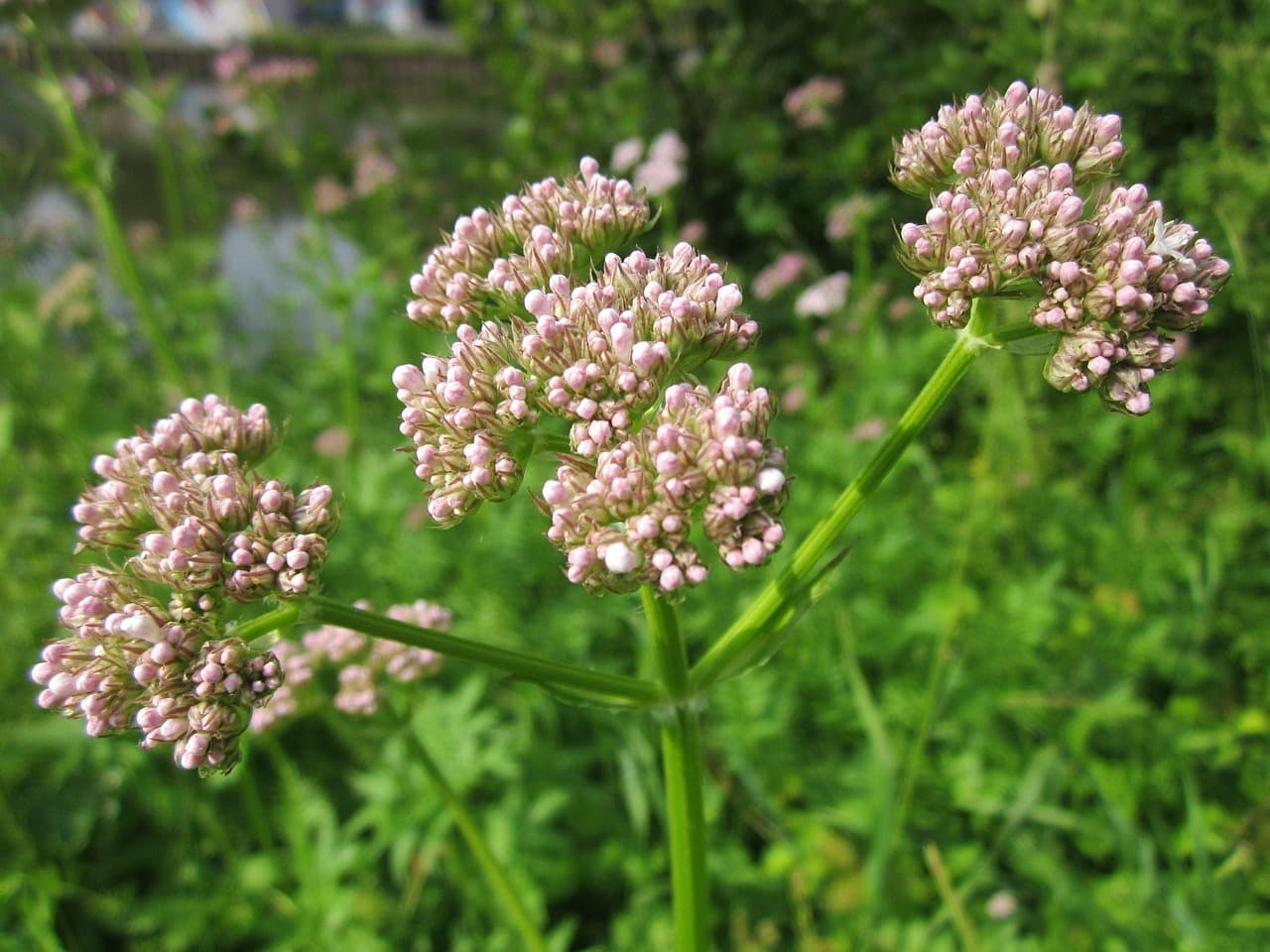
Overview
Valerian (Valeriana officinalis) is a flowering plant whose dried root is one of the most used herbal remedies for sleep problems1. In the European Union, medicines made from the root are authorised "for the relief of mild nervous tension and sleep disorders", and modern research has asked the same two questions: whether it helps people fall and stay asleep, and whether it eases anxiety.
A 2006 systematic review of 16 randomized, placebo-controlled trials in 1,093 people combined the six that measured sleep quality the same way and found a statistically significant benefit, though with signs of publication bias; most of the individual trials had methodological weaknesses, and doses, extracts, and treatment lengths varied a lot between studies2. A 2010 meta-analysis of 18 trials found a telling split: people taking valerian more often reported sleeping better, but the time it took them to fall asleep did not differ from placebo3. A larger and more recent systematic review covered 60 studies with almost 6,900 people but pooled only some of them: 10 trials (1,065 people) for sleep quality and 8 trials (535 people) for anxiety. Both combined estimates leaned toward benefit without reaching statistical significance, and the individual results varied widely4. A 2024 randomized, double-blind, placebo-controlled trial in 80 adults with sleep complaints tested a standardized valerian root extract against placebo for 8 weeks and reported better overall sleep quality from day 14, faster sleep onset on a wrist-worn tracker from day 3, and, as a secondary outcome, a small drop in anxiety scores5. A separate Cochrane review focused specifically on anxiety disorders: it found only one eligible trial, a four-week pilot study in 36 people with generalized anxiety disorder that showed no significant difference from placebo, and concluded that the evidence was insufficient to judge either effectiveness or safety6.
Is this for you?
Why are you considering valerian?
This is not medical advice — just general orientation.
Safety
- The reviewed trials report few adverse events, mostly at rates similar to placebo, and no serious ones2,4. The Cochrane review of valerian for anxiety disorders found no difference in side effects or dropouts between valerian, diazepam and placebo, but it rested on a single 36-person trial, too little to judge safety6. Long-term safety data do not exist. The European Medicines Agency does not recommend valerian root for children under 12 "due to a lack of data on safety and efficacy," and does not recommend it during pregnancy or breastfeeding because its safety there "has not been established"; its 2016 monograph also notes that reproductive toxicity tests had not been performed, and warns that valerian "may impair ability to drive and use machines". The NIH Office of Dietary Supplements is less strict about children, advising against use only under three, and says valerian should not be taken during pregnancy or breastfeeding without medical advice. The only human pregnancy data we found come from Sweden's medical birth register: 787 of 860,215 women reported using herbal medicines in early pregnancy, valerian among the three most common, and their babies showed no signs of harm — but there were too few exposures to rule out rare birth defects7. Treat these as open gaps rather than an assumption of safety.
Dosage
The reviewed studies did not use a single consistent dose — a systematic review of 16 trials noted that valerian doses (225 to 1,215 mg a day), preparations, and treatment lengths "varied considerably" between studies2. The 2024 randomized controlled trial tested 200 mg of a standardized Valeriana officinalis extract (2% valerenic acids), taken an hour before bed for 8 weeks5. Because of this variability, no single reliable "studies used X mg/day" figure can be given from our review. Beyond our review, Examine puts the studied range for insomnia at 300 to 600 mg of extract a day (Examine.com), and the NIH Office of Dietary Supplements describes a small trial in eight people in which 450 mg cut the time to fall asleep from about 16 minutes to 9, while 900 mg produced no significant shortening (NIH ODS). That eight-person result is not the rule: a 2010 meta-analysis of 18 trials found no difference from placebo in the time needed to fall asleep3.
How long valerian is taken matters as much as how much. The European Medicines Agency describes valerian root as having a "gradual onset of efficacy," says it is not suitable for quick relief, recommends continuous use over 2–4 weeks for the best effect, and advises seeing a doctor or pharmacist if symptoms persist or worsen after 2 weeks. The trials point the same way without settling it. In a small crossover study of 16 people with insomnia, a single dose changed nothing, while after 14 days of use deep sleep began sooner than on placebo8; in the 2024 trial the overall sleep-quality score improved from day 145; yet a two-week trial in 16 older women found no benefit at all9. The controlled trials cited here lasted weeks, not months — 6 weeks against the sedative oxazepam in 202 adults10 and 8 weeks in the 2024 trial — so they say nothing about use over many months or about breaks between courses.
Where to find it
As an Amazon Associate, Holistic Codex earns from qualifying purchases. Product recommendations are editorially independent.
Interactions
The only interaction data in the reviewed studies come from two studies cited in the 2020 review, which found no significant effect on CYP1A2, CYP2D6, CYP2E1 or CYP3A4/5, liver enzymes that break down many drugs4. Beyond our review, the NIH Office of Dietary Supplements warns that valerian might add to the sedative effect of alcohol, benzodiazepines, barbiturates and other central nervous system depressants, and of supplements such as kava and melatonin; for alcohol and sedative drugs it calls this a theoretical possibility (NIH ODS). That matters most for the people most likely to stack it with something else for sleep.
Traditional Use
Ayurveda
India · over 3,000 years
Ayurveda knows a herb called tagara — but it is a DIFFERENT SPECIES: Valeriana jatamansi (synonym V. wallichii), a Himalayan relative of European valerian. That this is geography rather than a mix-up of names is clear from distribution data: of 397,061 occurrence records for Valeriana officinalis, 21 come from India and none at all from Pakistan, Nepal or Bhutan, while V. jatamansi is recorded 825 times in China, 127 in India, 59 in Nepal, 42 in Pakistan and 29 in Bhutan, and not once in Britain, France, the Netherlands, Germany or Slovakia (GBIF). The herb classical Ayurveda was describing is therefore the Himalayan species, not the European one. In the Sushruta Samhita (Bhishagratna translation, 1907), tagara appears as an ingredient of compound preparations rather than a standalone sleep remedy: in a medicated ghee for a child moving on to solid food, in the aromatic oil Gandha-taila cooked in cow's milk, and among the substances of a warming regimen alongside saffron, aguru and cardamom. No standalone claim about sleep or insomnia appears in the passages read. The verdict is therefore "unstudied" rather than "refuted": Ayurveda says nothing about whether European valerian helps sleep — it used a different plant, for different purposes.
What the science says
Not yet studiedThe distinction matters for reading the modern evidence too: the trials and meta-analyses that built valerian's reputation for sleep were run on Valeriana officinalis, the European species5,2,4, so they neither support nor refute what Ayurveda did with tagara. They are about a different plant.
TCM
China · over 2,000 years
Chinese materia medica does have a valerian — and it is the third species so far. It is called 蜘蛛香, "spider fragrance," and it is Valeriana jatamansi, the same Himalayan plant Ayurveda knows as tagara. Li Shizhen describes it exactly in the Bencao Gangmu (1596): a root from the Songpan mountains of western Sichuan, black with coarse whiskers, shaped like a spider, aromatic — and he adds the line any cat owner will recognise: "it is said that cats like to eat it"12. What he assigned it to has nothing to do with sleep: it wards off epidemic pestilence, malign influences and "corpse-infusion." It is a remedy for plague and possession, not for insomnia.
What the science says
DisputedWhat decides this is not whether the canon knew the plant — it did. What decides it is that insomnia was handled elsewhere and with something else: the same Bencao Gangmu gives sour jujube seed (酸棗仁) a long entry specifically about sleep, distinguishing the roasted form for "gallbladder-deficiency sleeplessness" from the raw form for the opposite state, and citing named decoctions called 酸棗仁湯13. The tradition had both the plant and the complaint and did not join them — the same shape as the European and Tibetan entries above. The trials that built valerian's reputation for sleep were also run on Valeriana officinalis5,2, a different species from the Chinese 蜘蛛香.
Japanese Kampo
Japan · since the 7th century
Japanese Kampo rests on two Chinese classics by Zhang Zhongjing — the Shang Han Lun and the Jin Gui Yao Lue — and valerian appears in neither. Nor does it appear in the Yojokun (1713), Kaibara's health manual, which we have in full and which devotes its own advice to sleep. What the Jin Gui Yao Lue does contain is a named decoction for exactly this complaint: 酸棗仁湯, sansonin-to in Japanese, indicated for "taxation, vexation and inability to sleep"14. Japan has its own valerian — Valeriana fauriei, 吉草根 kisso-kon in the pharmacopoeia — and the national library lists dozens of titles under that name; but the full text of the Japanese herbal, Kaibara's Yamato Honzo, we could not read.
What the science says
Not yet studiedHence "unstudied" rather than "refuted." We cannot show that Kampo knew valerian and withheld sleep from it — only that it is absent from the readable classical corpus and that insomnia there is treated with sour jujube seed. Modern research measured the European species; it has not tested Japanese V. fauriei, so it speaks to that branch neither way.
Unani
Greco-Persian lineage · since Avicenna
The Greco-Arabic line has a relative in play rather than valerian itself: sumbul, that is spikenard, Nardostachys jatamansi — the same Valerianaceae family. In Avicenna's Canon of Medicine it appears in the chapter on drugs acting on the "breath," and the property the text assigns it is to gladden: it stands there beside musk and amber as an agent of cheer, not of calm15. Two honest limits come with that and cannot be skipped. What is readable is Book I, the general principles; the materia medica sits in Book II and no free edition of it exists. And the word "valerian" occurs exactly once in the available translation — in the alphabetical drug list compiled by the translator Gruner in the twentieth century, not in Avicenna's own text.
What the science says
Not yet studiedThis is therefore a floor, not a ceiling: silence from a source that cannot be opened is not evidence of absence. All that can be said firmly is that the Valerianaceae which is genuinely present in the readable volume carries no role in sleep there.
European Herbalism
Europe · centuries of folk use
In Culpeper's herbal of 1653, The English Physitian Enlarged, garden valerian is listed under the influence of Mercury and credited with a "warming faculty": dried root in a drink was said to promote urination and ease difficult urination, a decoction was used for pains in the sides and to bring on menstruation, and the root boiled with liquorice, raisins, and aniseed was recommended for those short of breath or coughing. It was also given for venomous bites and stings, credited with "special virtue against the plague," used to expel wind in the belly, and crushed fresh and applied to the head to ease its pains11. Strikingly, Culpeper's entry contains no mention of sleep, insomnia, calming, or sedation at all. That association appears only later: King's American Dispensatory (1898) and Felter's Eclectic Materia Medica (1922) reclassify valerian as a remedy for the nervous system, linking it to nervous conditions and hysteria (the era's diagnosis for nervous complaints) and to sleep.
What the science says
DisputedModern trials offer some, though mixed, support for valerian's use for sleep2,4,5, but the historical record directly refutes the idea that European herbalism valued it for sleep "from the start" — the sleep/nervous-system use only entered the written tradition roughly two and a half centuries after Culpeper.
Tibetan Medicine (Sowa Rigpa)
Tibet · Sowa Rigpa
Tibetan medicine knows a valerian too, and it is a fourth species again: rgya spos, Valeriana tangutica, a plant of the Tibetan plateau. It sits in the standard Tibetan materia medica alongside spang spos, Nardostachys jatamansi — both Valerianaceae, neither of them the European plant this page is about. What decides the question is not whether the canon knew the plant but where it put it. The materia medica chapter gives the pair a single line: they treat old fever and fever from poisons. In the formulas, nard goes into compound powders for heat of the liver and lungs, into medicinal oils and baths, and into remedies against poisons and contagion; in the chapter on wind disorders both plants go into a medicated butter said to overcome lingering wind disease, stiffness, madness and forgetfulness. Sleep is not among their uses. And the canon is not silent about sleeplessness — it names what to use against it, and the list is food and oil: milk, curd, chang, meat and broth, oil rubbed into the head and instilled into the ears. Elsewhere insomnia appears again among the indications for oil massage, in the same breath as old age and grief. Valerian is on neither list.
What the science says
DisputedThis is therefore a tradition that had both the plant and the complaint and did not join them — the same shape as the European entry above, not a gap in the record. Two limits are worth stating plainly. The Tantra of Explanations and the Subsequent Tantra were searched in full in Dashiev's Russian translation (1988); the Instructional Tantra, which holds the treatment of individual diseases, is not part of that translation online, so it was searched in the Tibetan text, where none of the short passages naming nard mentions sleep. And the botanical identification comes from a published dataset of Tibetan materia medica whose sources include the Four Tantras and Gawé Dorjé's Stainless Crystal Mirror, so it describes the tradition's canon as a whole rather than one named chapter; the Russian translation names rgya spos as a Patrinia, a relative from the same family, so the species itself is less settled than one name suggests.
What biohacking says
Biohacking
21st century · data & self-tracking
Valerian is the default herbal sleep aid in self-tracking circles, usually taken half an hour to two hours before bed, and it is the one entry on this shelf with no longevity story at all: searching all 3,423 DrugAge records returns nothing for valerian, so the compound has never been tested for lifespan in any organism. What it does have is human trials, and they are unusually honest about their own limits. Examine covers 37 references and 2,992 participants in 8 trials and 2 meta-analyses, and nothing reaches the top two evidence grades — four outcomes sit at the third and three at the fourth (Examine.com). The NIH Office of Dietary Supplements reaches the same place from a different direction, calling the evidence for insomnia inconclusive and noting there is no scientific agreement on how valerian even works (NIH ODS). The most useful single finding is a dose one: in a small top-rated trial of eight people, 450 mg of valerian extract cut the time to fall asleep from about 16 minutes to 9 — while 900 mg produced no significant shortening at all. Examine puts studied doses at 300 to 600 mg.
What the science says
PartialTwo things the enthusiasm tends to skip. Long-term safety data do not exist, so "gentle because it is herbal" is an assumption rather than a finding. And valerian might add to the effect of alcohol, benzodiazepines, barbiturates and other sedatives including melatonin and kava — for alcohol and sedative drugs the NIH fact sheet calls it a theoretical possibility, but it matters most for exactly the people most likely to stack it (NIH ODS).
Evidence Strength
Valerian for sleep has been studied in multiple systematic reviews and meta-analyses covering thousands of participants across dozens of trials, plus a recent standalone randomized controlled trial, which gives it a modest and inconsistent evidence base for improving subjective sleep quality — though the reviews themselves note that individual trials varied widely in quality, dose, and preparation, which limits precision about "how much" and "which extract" works best. Measured sleep is where the evidence splits: a 2010 meta-analysis of 18 trials found no difference in the time needed to fall asleep3, a 2024 umbrella review of eight systematic reviews found improvement in how people rated their sleep but not on objective measures1, and the American Academy of Sleep Medicine suggests that clinicians not use valerian for chronic insomnia, a weak recommendation16 — while the 2024 trial did record faster sleep onset on a wrist tracker. In the EU, medicines made from valerian root are authorised for mild nervous tension and sleep disorders, yet the evidence for anxiety disorders is weaker still: the 2020 review's pooled analysis of eight small trials did not reach statistical significance, a Cochrane review of anxiety disorders found a single 36-person trial with no difference from placebo, and a 2022 network meta-analysis of 29 trials on herbal treatments for anxiety found insufficient evidence to confirm valerian's effect17. Short-term trials report few adverse events, at rates similar to placebo, but long-term safety data do not exist, and the European Medicines Agency does not recommend valerian during pregnancy, while breastfeeding, or for children under 12. On interactions, two studies cited in the 2020 review found no significant effect on major drug-metabolizing liver enzymes, while the NIH Office of Dietary Supplements flags possible added sedation with alcohol, sedative drugs, and supplements such as kava and melatonin.
Frequently Asked Questions
Medical Disclaimer: This article is for educational purposes only and does not constitute medical advice. Always consult a qualified healthcare professional before starting any supplement regimen or making changes to your diet, especially if you have a medical condition or take medications.
Sources
- 1
Valente V, et al.. Does valerian work for insomnia? An umbrella review of the evidence.. European neuropsychopharmacology : the journal of the European College of. 2024.
Strong EvidencePubMed ↗ - 2
Bent S, et al.. Valerian for sleep: a systematic review and meta-analysis.. The American journal of medicine. 2006.
Strong EvidencePubMed ↗ - 3
Fernandez-San-Martin MI, et al.. Effectiveness of Valerian on insomnia: a meta-analysis of randomized placebo-controlled trials.. Sleep medicine. 2010.
Strong EvidencePubMed ↗ - 4
Shinjyo N, et al.. Valerian Root in Treating Sleep Problems and Associated Disorders-A Systematic Review and Meta-Analysis.. Journal of evidence-based integrative medicine. 2020.
Strong EvidencePubMed ↗ - 5
Chandra Shekhar H, et al.. Standardized Extract of Valeriana officinalis Improves Overall Sleep Quality in Human Subjects with Sleep Complaints: A Randomized, Double-Blind, Placebo-Controlled, Clinical Study.. Advances in therapy. 2024.
Strong EvidencePubMed ↗ - 6
Miyasaka LS, et al.. Valerian for anxiety disorders.. The Cochrane database of systematic reviews. 2006.
Strong EvidencePubMed ↗ - 7
Holst L, et al.. Use of herbal drugs during early pregnancy in relation to maternal characteristics and pregnancy outcome.. Pharmacoepidemiology and drug safety. 2008.
Strong EvidencePubMed ↗ - 8
Donath F, et al.. Critical evaluation of the effect of valerian extract on sleep structure and sleep quality.. Pharmacopsychiatry. 2000.
Strong EvidencePubMed ↗ - 9
Taibi DM, et al.. A randomized clinical trial of valerian fails to improve self-reported, polysomnographic, and actigraphic sleep in older women with insomnia.. Sleep medicine. 2009.
Strong EvidencePubMed ↗ - 10
Ziegler G, et al.. Efficacy and tolerability of valerian extract LI 156 compared with oxazepam in the treatment of non-organic insomnia--a randomized, double-blind, comparative clinical study.. European journal of medical research. 2002.
Strong EvidencePubMed ↗ - 11
Wellcome Collection — classical source text
- 12
Chinese Wikisource — classical source text
- 13
Chinese Wikisource — classical source text
- 14
Chinese Wikisource — classical source text
- 15
Internet Archive — classical source text
- 16
Sateia MJ, et al.. Clinical Practice Guideline for the Pharmacologic Treatment of Chronic Insomnia in Adults: An American Academy of Sleep Medicine Clinical Practice Guideline.. Journal of clinical sleep medicine : JCSM : official publication of the American. 2017.
Strong EvidencePubMed ↗ - 17
Zhang W, et al.. Medicinal herbs for the treatment of anxiety: A systematic review and network meta-analysis.. Pharmacological research. 2022.
Strong EvidencePubMed ↗
Contextual Data Sources


