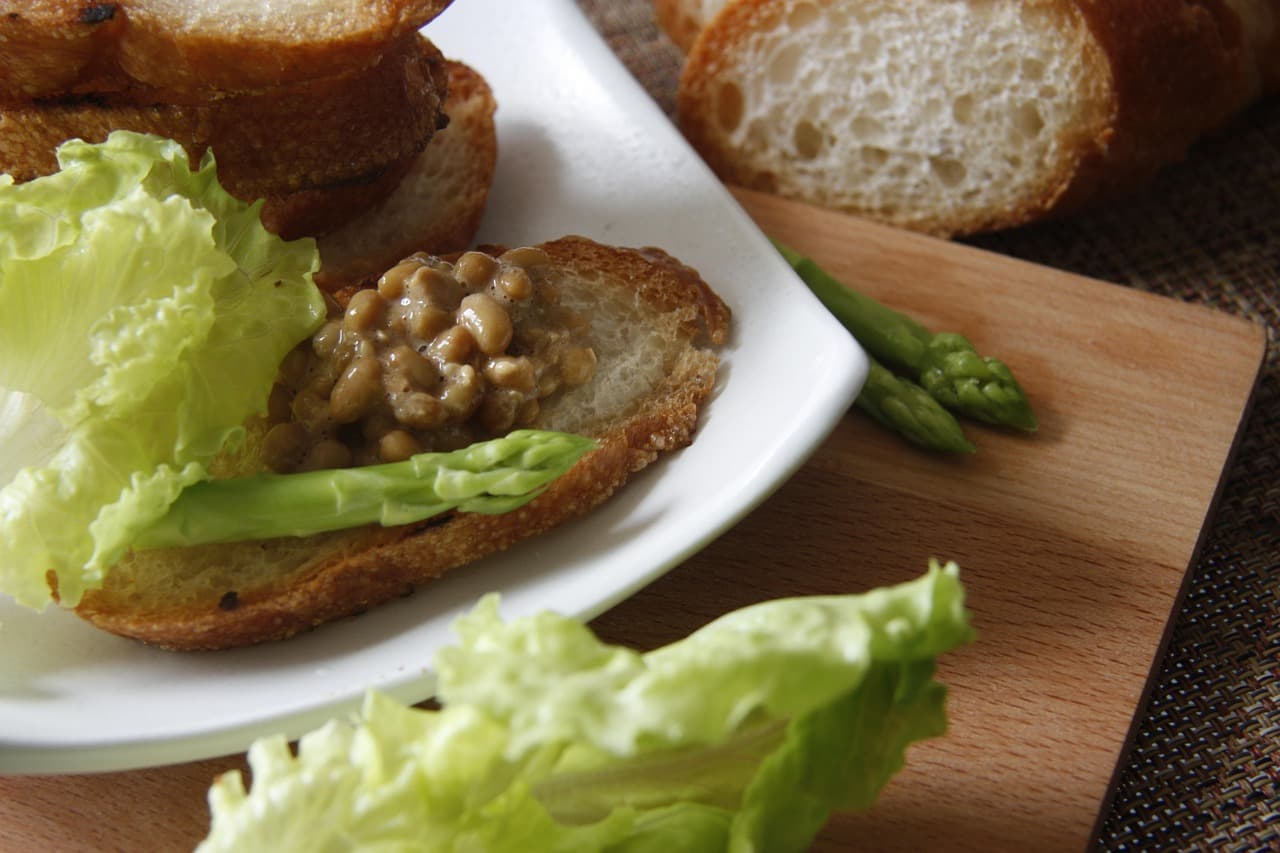
Crispy sourdough topped with sticky, savory natto makes for a surprisingly satisfying breakfast that bridges Japanese tradition and modern convenience.
Servings
2
Prep
5 min
Cook
4 min
Natto toast is one of those rare dishes where something ancient meets something effortless. Natto — fermented soybeans with a sticky, stringy texture and a deep umami flavour — might seem like an unusual toast topping, but once you try it, the combination is genuinely compelling. The crunch of toasted sourdough contrasts beautifully with the soft, pungent natto, while a few simple toppings — mustard, soy sauce, and sliced green onion — tie everything together. This recipe keeps things approachable whether you are a natto veteran or trying it for the very first time.
Ingredients
- 2 thick slices sourdough bread (about 120 g total)
- 1 pack natto (50 g), typically sold in individual styrofoam or paper packs
- 1 tsp soy sauce
- 1 tsp Japanese mustard (karashi) or Dijon mustard
- 1 tsp sesame oil
- 1 green onion (scallion), thinly sliced
- ½ tsp toasted sesame seeds
- 1 soft-boiled or fried egg (optional)
- A few drops of sriracha or chili flakes (optional, for heat)
Instructions
- Toast the sourdough slices in a toaster or under a grill until golden and crisp, about 3–4 minutes.
- Open the natto pack. Add the included sauce packet (if any), the soy sauce, mustard, and sesame oil directly into the natto container or a small bowl.
- Stir the natto vigorously with chopsticks or a fork for about 30–60 seconds until it becomes very sticky and stringy. This develops the flavour and texture.
- Spoon the natto mixture evenly over the toasted bread slices.
- Top with sliced green onion and toasted sesame seeds.
- If using, place a soft-boiled or fried egg on top.
- Add a few drops of sriracha or a pinch of chili flakes if you like heat. Serve immediately.
Tips
- Stir well: The more vigorously you stir natto before topping, the richer and more cohesive the flavour becomes — don't skip this step.
- Bread choice: Sourdough works best for its tang and structure, but rye or whole-grain toast are excellent alternatives.
- Storage: Natto packs keep well in the fridge for up to a week and can be frozen for up to a month. Thaw overnight in the fridge before use.
- Toppings to try: Thinly sliced avocado, a drizzle of ponzu, pickled ginger, or shredded nori all pair beautifully with natto on toast.
Natto has been a staple of Japanese cuisine — particularly in the Kantō region around Tokyo — for over a thousand years. Traditionally eaten as a breakfast food alongside rice, miso soup, and pickles, it is made by fermenting soybeans with the bacterium Bacillus subtilis var. natto, giving it its signature sticky texture and bold, complex aroma. Serving natto on toast is a modern adaptation that has become popular in Japan as Western-style breakfasts have woven into everyday life.
What natto actually brings to the toast
Natto is not just an unusual topping with a strong personality. It is the richest natural food source of menaquinone-7, the long-chain form of vitamin K21 — and that is the one nutritional claim about it that has been examined properly rather than simply asserted.
A 2025 meta-analysis pooled six Japanese studies covering 2,327 people and compared habitual natto eaters with those who rarely or never touch it1. The regular eaters had substantially higher blood levels of MK-7, and less of their osteocalcin — the protein vitamin K switches on so that it can bind calcium into bone — was left sitting in its inactive form. Bone mineral density was modestly higher as well. The authors are careful about how far this goes, and so are we: the MK-7 finding carries moderate certainty, the bone findings low to very low, because nearly all the underlying studies are observational and every one of them is Japanese. Eating natto is reliably associated with better vitamin K status. That it builds bone is a further step the evidence has not yet taken.
One group should not eat it at all
If you take warfarin, natto is off the menu. Its vitamin K2 content is high enough to work directly against the drug, and this is not a theoretical caution: Japanese researchers went to the trouble of breeding a mutant Bacillus subtilis strain producing only about a fifth of the usual MK-7, specifically so that warfarin patients could eat natto at all2. Ordinary natto — the kind this recipe calls for — is precisely what that product exists to replace. If you are on any anticoagulant, ask your doctor before this becomes a regular breakfast rather than after.
As an Amazon Associate, Holistic Codex earns from qualifying purchases. Product recommendations are editorially independent.
Nutrition of key ingredients — per 100 g of each ingredient separately (not per serving), source USDA
| Ingredient | kJ / kcal |
|---|---|
| natto | 883 / 211 |
| sourdough bread | 1138 / 272 |
| soy sauce | 251 / 60 |
| green onions | 113 / 27 |
| sesame oil | 3699 / 884 |
Frequently Asked Questions
Medical Disclaimer: This article is for educational purposes only and does not constitute medical advice. Always consult a qualified healthcare professional before starting any supplement regimen or making changes to your diet, especially if you have a medical condition or take medications.
Sources
- 1
Wen Z, et al.. Habitual natto intake elevates serum MK-7 levels, enhances osteocalcin carboxylation, and supports bone density: a meta-analysis of Japanese evidence.. Frontiers in nutrition. 2025.
Traditional UsePubMed ↗ - 2
Nakajima T, et al.. First Clinical Trial of a Newly Developed, Low Menaquinone-7, Fermented Soybean Natto in Warfarin-Dependent Patients.. Journal of medicinal food. 2021.
Traditional UsePubMed ↗