Overview
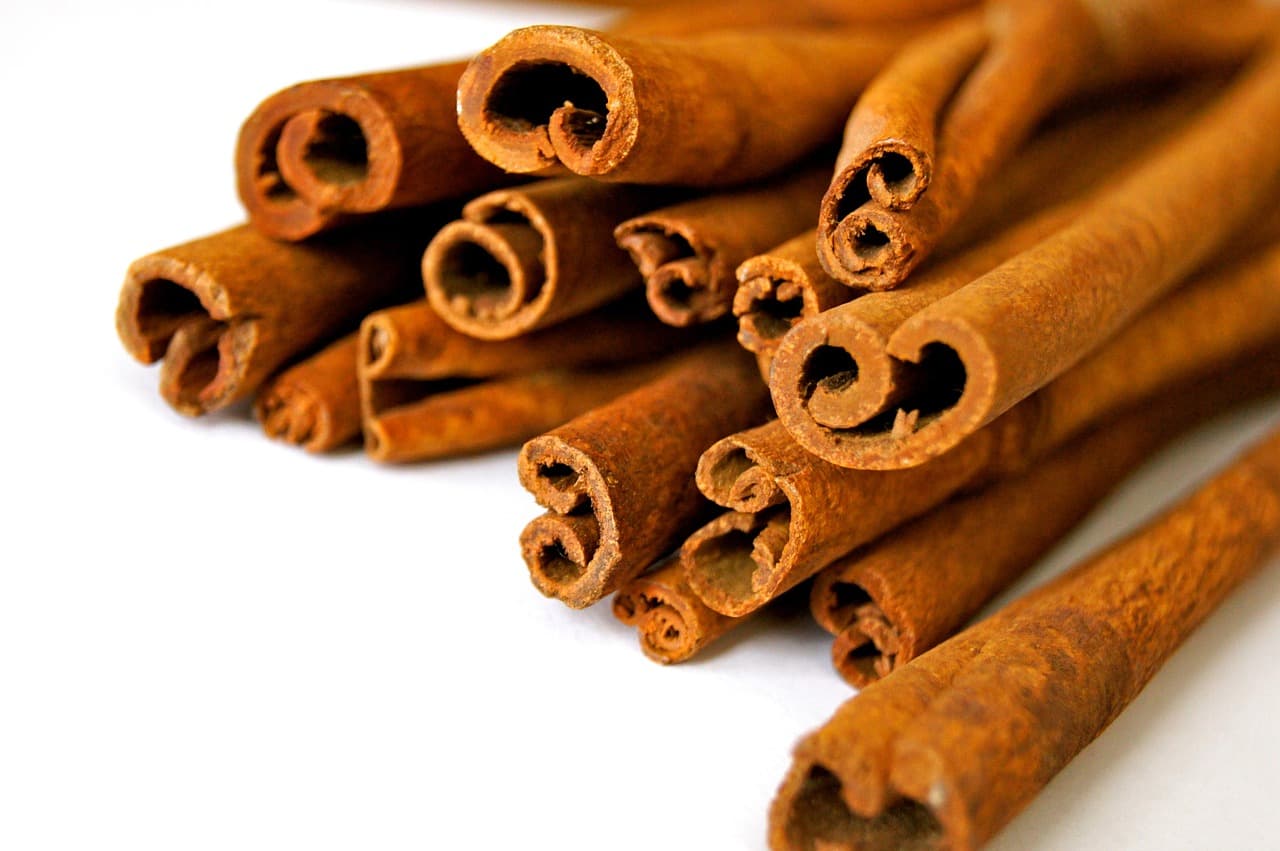
Cinnamon is the aromatic inner bark of trees in the genus Cinnamomum, most often Cinnamomum verum ("true" or Ceylon cinnamon) or related species, dried and sold as sticks, powder, or extract1. Beyond the kitchen spice, it has drawn serious research attention for blood sugar control in type 2 diabetes: three separate meta-analyses pooling dozens of randomized controlled trials found that cinnamon supplementation lowered fasting blood sugar, and one also found improvements in insulin resistance (a measure of how well your body responds to insulin)1,2,3. Cinnamon oil, a concentrated extract, also shows antibacterial and anti-inflammatory activity against common pathogens like Staphylococcus aureus and E. coli in laboratory settings.
Some of the antimicrobial evidence for cinnamon comes from lab and food-preservation research rather than studies in people — for example, cinnamon essential oil inhibited fungal growth on mango and chayote fruit in petri-dish and postharvest trials, and was combined with other materials into antibacterial wound-dressing films4. These are useful preliminary signals about cinnamon's chemistry, but they don't tell us what a therapeutic dose does inside a human body.
Is this for you?
Why are you considering cinnamon?
This is not medical advice — just general orientation.
Safety
- The reviewed meta-analyses focus on glycemic outcomes and do not report detailed adverse-event data for oral cinnamon supplementation, so specific side-effect rates are not available from our review. Because cinnamon supplementation lowered fasting blood sugar in these trials, anyone already on glucose-lowering medication should be aware of a plausible additive effect (see Interactions). No data on use during pregnancy or breastfeeding was found in the reviewed studies. No human safety data was found in the reviewed studies for cinnamon essential oil use on skin or in food-packaging applications — the antimicrobial films and postharvest studies cited here are laboratory/in-vitro work, not human safety trials4.
Dosage
Meta-analyses pooling randomized controlled trials in type 2 diabetes patients used a wide range of cinnamon doses and durations across the 24+ trials analyzed, generally administered as oral cinnamon powder or extract over periods ranging from several weeks to a few months2,3,1. The individual per-trial dose ranges are not broken out in our review, so a single specific daily amount cannot be stated here. Traditional Ayurvedic sources describe classical powder doses of 1 to 3 grams within formulas such as Sitopaladi Churna, but this reflects historical practice for digestive/respiratory use, not the diabetes-research dosing.
Where to find it
As an Amazon Associate, Holistic Codex earns from qualifying purchases. Product recommendations are editorially independent.
Interactions
Because cinnamon supplementation has been shown across meta-analyses to lower fasting blood sugar in people with type 2 diabetes, there is a plausible interaction with glucose-lowering medications that could increase the risk of blood sugar dropping too low, though the reviewed studies do not report specific drug-interaction data1,2,3. No other drug or herb interactions are documented in the reviewed studies.
Traditional Use
Ayurveda
India · over 3,000 years
Ayurveda knows cinnamon bark as Tvak, classified as pungent, bitter, and sweet, said to calm the kapha and vata doshas (constitutional energies). The Ayurvedic Pharmacopoeia of India credits it with kindling agni (digestive fire) and clearing the throat, placing it in classical formulas like Sitopaladi Churna, traditionally dosed at 1 to 3 grams of powder. Read closely, the classical indications concern digestion and breathing — not blood sugar, a concept Ayurveda does not have.
TCM
China · over 2,000 years
In Traditional Chinese Medicine, cinnamon bark is Rou Gui, indicated with unusual precision to expel "cold from deficiency" settled in the spleen and stomach. A practitioner reaches for it when digestion has turned cold and sluggish, when abdominal pain eases with warmth, and when appetite has vanished, and it appears in formulas such as Gui Fu Li Zhong Wan built exactly on that pattern. TCM has its own category for a diabetes-like condition (消渴, "wasting thirst"), but cinnamon is not a central herb in its prescriptions for it.
What the science says
Not yet studiedOur review documents no modern trial testing cinnamon against this specific "cold from deficiency" digestive pattern, so this traditional use remains unstudied by the diabetes-focused research summarized above.
Japanese Kampo
Japan · since the 7th century
Japanese Kampo is the one tradition here where cinnamon and diabetes genuinely meet on paper, though not the way a supplement label might suggest. Hachimijiogan, one of the most frequently prescribed Kampo formulas for age-related complaints including diabetes, contains Cinnamomi cortex at about 4.5% of the formula's weight — roughly one gram — alongside rehmannia, cornus, yam, alisma, poria, peony, and processed aconite. Kampo prescribes the whole formula for the pattern, not cinnamon for the sugar.
What the science says
Not yet studiedNo study in our review tests Hachimijiogan itself, so the formula's traditional pairing with diabetes symptoms remains unstudied even though cinnamon's own glycemic effect is studied separately.
Korean Medicine
Korea · Dongui Bogam (1613)
Korean medicine has a fully developed account of what is now called diabetes, known as sogal (消渴), "wasting thirst," and the 1613 medical text Dongui Bogam by Heo Jun records prescriptions aimed directly at it, including Gangsimtang, which is still studied clinically in Korea today. Notably, those prescriptions are built from rehmannia, ginseng, ophiopogon, and related herbs — cinnamon is not a central ingredient in them, which is arguably the more telling fact for this profile.
What the science says
Not yet studiedBecause Korean medicine's own diabetes formulas do not center on cinnamon, the modern glycemic research on cinnamon summarized above doesn't map onto a documented Korean traditional use.
Unani
Greco-Persian lineage · since Avicenna
Unani medicine calls cinnamon Darchini and places it at the warm and dry end of its temperament scale, at the second to third degree, using it as a tonic for the heart, liver, and stomach. Avicenna's Canon of Medicine describes it as an antidote and a remedy for heart palpitations, disorders of the mind, and fear — making it far more a heart and nerve herb than a metabolic one. Compound preparations point the same way, with Darchini appearing in formulations such as Jawarish.
What the science says
Not yet studiedOur review contains no modern trial testing cinnamon for heart palpitations, mood, or the cardiac/nervous indications Unani describes, so this traditional use is unstudied.
European Herbalism
Europe · centuries of folk use
European herbalism recorded cinnamon carefully and narrowly. Maud Grieve's 1931 compendium A Modern Herbal, which still underpins much Western herbal practice today, lists it as a carminative (relieves gas), astringent, stimulant, and antiseptic, noting that it stops vomiting, eases flatulence, and suits diarrhea. That is the entire classical entry — there is no mention of diabetes, blood sugar, or wasting diseases that European physicians of the era already recognized and named.
Tibetan Medicine (Sowa Rigpa)
Tibet · Sowa Rigpa
Sowa Rigpa, the medicine of Tibet, rarely administers a single herb alone — cinnamon reaches the patient inside a composed formula. The five-ingredient formula Se-'bru 5 combines it with pomegranate, long pepper, and cardamom, and the classical materia medica states its purpose directly: to raise "stomach heat" and settle heaviness and bloating after eating. This is a digestive prescription, and the tradition is consistent about it.
What the science says
Not yet studiedNo modern trial in our review tests Se-'bru 5 or isolated cinnamon for post-meal bloating or "stomach heat," so this traditional digestive use is unstudied.
What biohacking says
Biohacking
21st century · data & self-tracking
Cinnamon is the cheapest item in the blood-sugar corner of biohacking, usually taken as a spoonful of powder with a carbohydrate meal on the theory that it blunts the glucose response. The human evidence is real but modest: Examine covers 96 references and 18,886 participants with 15 meta-analyses, and not one outcome reaches its top evidence grade — blood pressure and six others sit at the second, one at the lowest (Examine.com). The honest part is the dosing, because Examine will not name a precise effective dose at all: for glycemic control it says roughly 2 to 4 grams a day while noting that dose-response studies are missing and meta-regressions disagree, and for blood pressure it suggests 2 grams or less. Studied doses range from 0.1 to 14 grams a day. Nobody knows whether it should be taken with food, because that has not been properly tested. The longevity angle is thinner still: DrugAge holds four cinnamon records, and two of them are negative — cinnamon extract added 17 and 37 percent to fruit fly lifespan5, while supercinnamaldehyde shortened nematode lifespan by 4 and 10 percent without reaching significance6.
What the science says
PartialTwo of the four animal records point the wrong way, and the human dosing advice is an estimate wrapped in a disclaimer. That is what a genuinely promising but under-tested supplement looks like from the inside, and it is a different thing from one that has been shown not to work.
Evidence Strength
Cinnamon's effect on blood sugar in type 2 diabetes is backed by three separate meta-analyses pooling dozens of randomized controlled trials, which is a solid, repeated evidence base for that one outcome1,2,3. Its antimicrobial and anti-inflammatory properties, by contrast, rest mostly on laboratory and food-science research rather than human trials, so those effects remain preliminary as far as people are concerned. The traditional uses documented across seven healing systems are almost entirely digestive or circulatory, and largely separate from — not confirmed or refuted by — the modern blood-sugar research.
Frequently Asked Questions
Medical Disclaimer: This article is for educational purposes only and does not constitute medical advice. Always consult a qualified healthcare professional before starting any supplement regimen or making changes to your diet, especially if you have a medical condition or take medications.
Sources
- 1
Leach MJ, et al.. Cinnamon for diabetes mellitus.. The Cochrane database of systematic reviews. 2012.
Strong EvidencePubMed ↗ - 2
Moridpour AH, et al.. The effect of cinnamon supplementation on glycemic control in patients with type 2 diabetes mellitus: An updated systematic review and dose-response meta-analysis of randomized controlled trials.. Phytotherapy research : PTR. 2024.
Strong EvidencePubMed ↗ - 3
Allen RW, et al.. Cinnamon use in type 2 diabetes: an updated systematic review and meta-analysis.. Annals of family medicine. 2013.
Strong EvidencePubMed ↗ - 4
Motelica L, Ficai D, Petrisor G, Oprea OC, Trușcǎ RD, Ficai A, Andronescu E, Hudita A, Holban AM.. Antimicrobial Hydroxyethyl-Cellulose-Based Composite Films with Zinc Oxide and Mesoporous Silica Loaded with Cinnamon Essential Oil.. Pharmaceutics. 2024.
Strong EvidenceEurope PMC ↗ - 5
Schriner SE, et al.. Extension of Drosophila lifespan by cinnamon through a sex-specific dependence on the insulin receptor substrate chico.. Experimental gerontology. 2014.
Strong EvidencePubMed ↗ - 6
Lombard DB, et al.. High-throughput small molecule screening reveals Nrf2-dependent and -independent pathways of cellular stress resistance.. Science advances. 2020.
Strong EvidencePubMed ↗