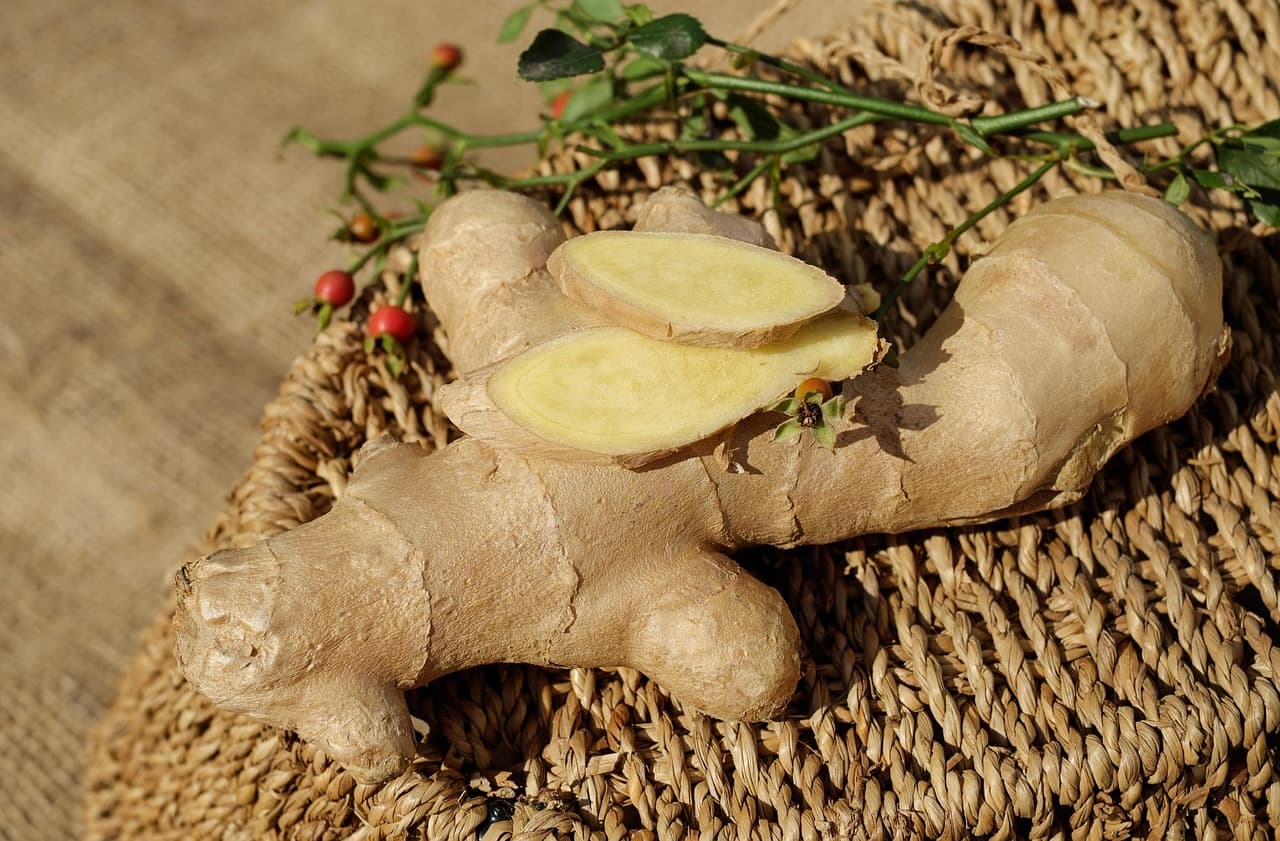
Overview
Ginger is the rhizome (underground stem) of Zingiber officinale, a plant used both as a kitchen spice and as a remedy across several traditional medical systems. Its best-studied active compounds are gingerols, shogaols, zingerone and paradols, which laboratory research links to antioxidant and anti-inflammatory activity through pathways like Nrf2 activation and NF-κB modulation1,2.
The strongest human evidence in this profile concerns menstrual cramps. A 2024 meta-analysis pooling multiple trials found ginger measurably reduced pain intensity in primary dysmenorrhea (period pain not caused by an underlying condition)3. An earlier meta-analysis of nine trials with 647 women found ginger outperformed placebo for period pain, with an even larger effect size than cinnamon or fennel in the same analysis4. Ginger also has a long documented history as a warming remedy for joint pain and stiffness across Traditional Chinese Medicine, Kampo, Korean medicine, Ayurveda, Unani, and European herbalism, detailed below.
Is this for you?
Why are you considering ginger?
This is not medical advice — just general orientation.
Safety
- The studies reviewed for this profile do not report human safety data, side effects, or contraindications for ginger — neither of the two dysmenorrhea meta-analyses3,4 described adverse events or who should avoid it. No reassurance can be given beyond what's documented: this profile cannot say ginger is safe for any particular group, including pregnant women, people on medication, or those with bleeding disorders, because that data simply isn't in the reviewed research. Talk to a doctor before use if you have any medical condition or take medication.
Dosage
The two meta-analyses on primary dysmenorrhea confirm ginger reduced pain intensity compared with placebo3,4, but the abstracts provided in our review report the pooled effect sizes (standardized mean differences and weighted mean differences) rather than a single agreed dose across the included trials. No consistent milligram-per-day figure from these clinical studies could be extracted from the material reviewed. Separately, a European herbalism source describes a traditional oral dose of a quarter to one gram of powdered ginger rhizome three times daily, as documented in the British Herbal Compendium and later carried into an EU traditional-use monograph — this is traditional-use documentation, not a clinical trial dose.
Where to find it
As an Amazon Associate, Holistic Codex earns from qualifying purchases. Product recommendations are editorially independent.
Interactions
No drug or herb interaction data was found in the reviewed studies. Neither meta-analysis on dysmenorrhea nor the reviews on ginger's antioxidant/anti-inflammatory activity reported interactions with medications or other herbs.
Traditional Use
Ayurveda
India · over 3,000 years
In Ayurveda, joint pain is understood to begin not in the joint itself but in a weakened digestive fire, which leaves behind ama — a toxic residue that settles in the body and causes amavata. Dried ginger (shunthi) is used to rekindle this digestive fire, clear kapha, and calm vata, typically within compound formulas like Shunthi-Guggulu rather than alone. The Ayurvedic pharmacopoeia distinguishes dried ginger from fresh ginger (ardraka) for this purpose, and the classical 16th-century text Bhavaprakasha Nighantu names the dried root by its own separate name.
What the science says
Not yet studiedNo human trial in our review tested dried ginger or Shunthi-Guggulu for amavata or joint pain.
TCM
China · over 2,000 years
The nearly two-thousand-year-old Jin Gui Yao Lue, attributed to Zhang Zhongjing around 200 CE, describes lì jié — joint swelling and stiffness — as a precursor to what TCM calls bì zhèng, "painful obstruction." Its formula Gui Zhi Shao Yao Zhi Mu Tang, still used today for rheumatoid arthritis-type complaints, gives fresh ginger the single largest dose of any herb in the formula, though in a supporting role helping the warming herbs expel wind, cold, and dampness from the body's pathways. A separate formula in the same text addresses lower back pain described as "heavy and cold, as if sitting in water."
What the science says
Not yet studiedNo study in our review tested ginger, alone or in this classical formula, for joint pain or rheumatoid-type complaints in humans.
Japanese Kampo
Japan · since the 7th century
In Kampo, ginger is called shokyo and appears in the formula Keishikajutsubuto, compiled by the physician Todo Yoshimasu and recorded in the text Hoki. Practitioners reach for it when joint pain and neuralgia flare together with a feeling of cold and swelling, following the logic that pain worsened by cold needs a remedy that warms while it relieves. The traditional portrait of this formula targets people of a delicate constitution whose hands and feet turn cold and numb.
What the science says
Not yet studiedNo study in our review tested this Kampo formula or ginger's role within it in a human trial.
Korean Medicine
Korea · Dongui Bogam (1613)
In the Dongui Bogam, written by Heo Jun in 1613, dried ginger (geongang) is described as intensely hot and pungent — a warming ally meant to loosen the limbs and joints and expel obstruction from wind, cold, and dampness, a pattern known as bi. The Korean Traditional Knowledge Portal still lists it today for Punghanseupbi and Pungseupbi, joint pain rooted in wind and dampness, but explicitly as a remedy for a cold pattern, to be avoided in conditions showing signs of heat. Dried ginger is also one of seven herbs in bi-syndrome formulas such as Oyaksungi-san.
What the science says
Not yet studiedNo human study in our review tested dried ginger or these formulas for joint pain.
Unani
Greco-Persian lineage · since Avicenna
In Unani medicine, ginger (Zanjabeel) is classified as hot in the third degree and dry in the second, giving it the character of muhallil-e-auram, a substance that resolves inflammatory swellings. Hakims (Unani physicians) have long used it for joint pain, rheumatism, and sciatica, reasoning that its heat expels a cold, sticky substance called balghami thought to settle in the joints. It is generally used within compound formulas such as Qurs-e-Mafasil rather than alone.
What the science says
Not yet studiedNo human trial in our review tested ginger, alone or in Qurs-e-Mafasil, for joint pain, rheumatism, or sciatica.
European Herbalism
Europe · centuries of folk use
Culpeper's London Dispensatory of 1653 says ginger "heats the joints, and therefore is profitable against the gout", and files it as hot and dry in the third degree and among the roots for the joints — the humoral logic of warming what is read as cold5,6. European herbal tradition also used ground ginger rhizome as a home remedy for creaky, sore joints, a use later documented in the British Herbal Compendium and carried into an EU traditional-use monograph, with a customary dose of a quarter to one gram taken three times daily.
What the science says
Not yet studiedNo trial in our review tested ginger for gout or general joint soreness in humans; the dysmenorrhea meta-analyses tested a different indication.
Tibetan Medicine (Sowa Rigpa)
Tibet · Sowa Rigpa
Tibetan materia medica lists ginger as སྒ་སྐྱ། sga skya — Zingiber officinale, family Zingiberaceae — in the class of herbaceous medicines8. The Four Tantras place it among the pungent, heating drugs beside black pepper, long pepper, garlic and asafoetida, and sum it up in a single line: it generates heat and suppresses diseases of wind. The practical uses follow directly — a decoction with rock salt and myrobalan for diminished heat and cold, with asafoetida and red salt for "wind of the heart," a winter drink against phlegm, and a place in the compound pomegranate powders for stomach fire, lost appetite and undigested food (Dashiev 1988). Tibetan ginger is therefore a remedy for cold and for digestion; to the joints, where the other six traditions send it, this canon never sends it at all.
What the science says
Not yet studiedNo study in our review tested ginger within these Tibetan compound formulas, or its role inside them.
What biohacking says
Biohacking
21st century · data & self-tracking
Ginger enters biohacking from two directions, and they are worth separating because their evidence is not comparable. The first is nausea and digestion, where 1 to 3 grams is the studied preventive dose and where ginger holds one of Examine's top evidence grades — nausea symptoms — across 2,025 participants in 21 trials and 2 meta-analyses, with two more outcomes at the second grade (Examine.com). That is an unusually clean result for a kitchen spice. The second direction is the testosterone claim that circulates in male-optimization forums, and its origin is worth stating plainly: the "superloading" figure of roughly 10 to 15 grams a day is a conversion from a RAT dose scaled by body surface area, not a dose that was tested in men. The same page says so directly. The longevity angle is the thinnest of all: DrugAge holds exactly one ginger record, 6-shogaol adding 25.9 percent to nematode lifespan7, with no mammal tested.
What the science says
PartialGinger is a good illustration of why "does the community take it" and "does it work" have to be answered separately. Both claims come from the same root and the same forums, but one rests on twenty-one human trials and the other on an arithmetic conversion from rats.
Evidence Strength
The evidence for ginger's most concrete human benefit — easing primary menstrual cramps — rests on two meta-analyses pooling a modest number of trials (nine studies covering 647 women in one of them), which is a reasonably solid signal but still built from a limited pool of underlying research. The antioxidant and anti-inflammatory mechanisms discussed in this profile come from lab and cell-based reviews, not from human trials, so they explain a plausible "why" without themselves proving an effect in people. Ginger's traditional use for joint pain across multiple systems of medicine is extensively documented historically, but none of it has been tested in a modern human study within our review, so those uses remain unstudied by that standard.
Frequently Asked Questions
Medical Disclaimer: This article is for educational purposes only and does not constitute medical advice. Always consult a qualified healthcare professional before starting any supplement regimen or making changes to your diet, especially if you have a medical condition or take medications.
Sources
- 1
Ayustaningwarno F, Anjani G, Ayu AM, Fogliano V.. A critical review of Ginger's (Zingiber officinale) antioxidant, anti-inflammatory, and immunomodulatory activities.. Frontiers in nutrition. 2024.
Strong EvidenceEurope PMC ↗ - 2
Pázmándi K, Szöllősi AG, Fekete T.. The "root" causes behind the anti-inflammatory actions of ginger compounds in immune cells.. Frontiers in immunology. 2024.
Strong EvidenceEurope PMC ↗ - 3
Moshfeghinia R, et al.. Ginger for Pain Management in Primary Dysmenorrhea: A Systematic Review and Meta-Analysis.. Journal of integrative and complementary medicine. 2024.
Strong EvidencePubMed ↗ - 4
Xu Y, et al.. Efficacy of herbal medicine (cinnamon/fennel/ginger) for primary dysmenorrhea: a systematic review and meta-analysis of randomized controlled trials.. The Journal of international medical research. 2020.
Strong EvidencePubMed ↗ - 5
Wellcome Collection — classical source text
- 6
Wellcome Collection — classical source text
- 7
Lee EB, et al.. Lifespan-extending property of 6-shogaol from Zingiber officinale Roscoe in Caenorhabditis elegans.. Archives of pharmacal research. 2018.
Strong EvidencePubMed ↗ - 8
Wangyal R, et al.. Dataset of materia medica in Sowa Rigpa: Tibetan medicine botanicals and Gawe Dorje's classification system.. Data in brief. 2020.
Strong EvidencePubMed ↗
Contextual Data Sources