Long before it was a candy flavor, licorice root was the go-to fix for a raw, scratchy throat, and modern operating rooms have quietly put that old habit to the test.
Licorice root sounds like the kind of folk remedy that belongs in a grandmother's tea tin, not a hospital anesthesia protocol. Yet that's exactly where some of the best evidence for it comes from. Researchers studying patients who wake up with a raw, burning throat after surgery have run a surprising number of trials on plain licorice gargles and lozenges, and the results line up with what herbalists have claimed for centuries.
What it is and how it works
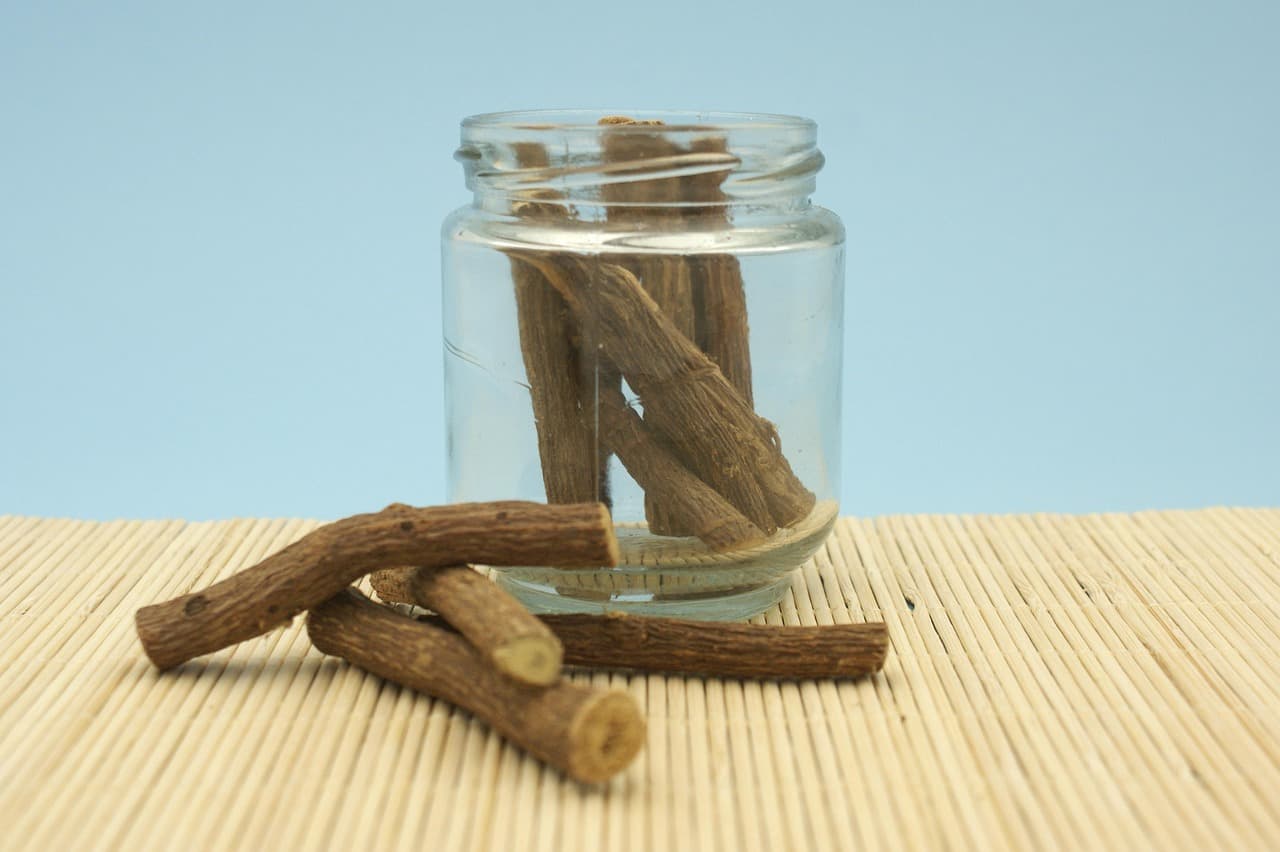
Licorice comes from the root of Glycyrrhiza glabra, a plant containing compounds with documented anti-inflammatory activity1. One of its main active constituents, liquiritin, has been shown in lab and animal research to calm inflammatory signaling by suppressing a stress-response pathway called JNK/Nur77/c-Jun, which lowers levels of inflammatory messengers like IL-6 and TNF-alpha in lung tissue2. In plainer terms: licorice seems to dial down the inflammatory chain reaction that makes throat tissue swollen, irritated, and painful. It also has a long history as a demulcent, meaning it coats and soothes irritated mucous membranes, and as an expectorant that helps loosen mucus, according to a phytochemical profile compiled by the USDA's Dr. Duke database.
Is this for you?
Why are you considering licorice for your throat?
This is not medical advice — just general orientation.
What the research shows
The strongest evidence here concerns postoperative sore throat, the ache people get after a breathing tube is placed for surgery. A 2019 systematic review and meta-analysis of randomized trials found that topical licorice, gargled or held in the mouth before anesthesia, reduced the incidence and severity of sore throat after intubation compared to controls1. Individual trials back this up. In 236 patients having thoracic surgery with large double-lumen breathing tubes, gargling a licorice solution before anesthesia cut both postoperative sore throat and post-tube coughing compared to a sugar-water gargle3. In smokers, generally more prone to airway irritation, licorice lozenges before surgery reduced cough, sore throat, and hoarseness compared to sugar candy in a trial of 100 patients4. A smaller study of 40 adults undergoing spinal surgery found licorice gargle lowered both the incidence and severity of sore throat at rest and on swallowing, tracked over 24 hours after surgery5. A 2022 trial comparing licorice gargle, green tea gargle, and a control group in 102 surgical patients found licorice measurably eased sore throat, cough, and hoarseness after the breathing tube came out6. Separately, a licorice mouthwash improved dry mouth and saliva flow in hemodialysis patients, a related but distinct throat and mouth comfort issue7.
Traditional perspective
Ayurveda
India · over 3,000 years
The Charaka Samhita, foundational text of Ayurveda, lists Madhuka (licorice) among its ten sacred Kanthya herbs, the special group prized for keeping the throat and voice healthy, traditionally simmered into a decoction or blended with honey for a scratchy throat, dry cough, or hoarseness10.
What the science says
ConfirmedThis lines up well with the soothing, throat-focused effect seen in the clinical trials.
TCM
China · over 2,000 years
In Traditional Chinese Medicine, the Shang Han Lun's protocol for Shaoyin-stage sore throat starts simply: Gan Cao Tang, licorice alone, and if the throat still aches, Jie Geng Tang, licorice with Platycodon, to finish the job, with licorice prized in this lineage for clearing heat and moistening a raw throat8.
What the science says
ConfirmedThis is arguably the most direct traditional parallel to the modern gargle trials, since both use licorice as a first-line, standalone throat remedy.
Japanese Kampo
Japan · since the 7th century
In Kampo medicine, licorice root (kanzo) is paired with Platycodon root in the formula Kikyo-to, reached for specifically when a sore, irritated throat signals the start of an upper respiratory infection, a combination descended from the classical Jie Geng Tang and used to soothe throat symptoms directly rather than treat the infection broadly9.
What the science says
ConfirmedThis matches the modern trials above almost precisely, since both target throat comfort itself rather than the underlying illness.
Korean Medicine
Korea · Dongui Bogam (1613)
In Korean medicine, gamcho (licorice root) is used when a sore, swollen throat or nagging cough appears, valued for gently moistening the lungs and calming coughing, and it's also added to countless formulas simply to harmonize other herbs together, making it one of the most widely used herbs in Korean prescriptions11.
What the science says
ConfirmedThat dual role as both remedy and harmonizer isn't something the surgical trials tested, but the throat-soothing use itself tracks closely with the research.
Unani
Greco-Persian lineage · since Avicenna
Unani physicians classify asl-us-soos (licorice root) as a demulcent and munzij, a 'concoctive' that helps ripen and move phlegm, turning to it for dry, stubborn coughs and bronchitis both alone and in compound formulas, with classical texts recording it plainly as an expectorant and antitussive12.
What the science says
PartialThis broader respiratory framing partially aligns with the throat-specific findings above, though it extends further into cough and bronchitis than the surgical trials directly measured.
European Herbalism
Europe · centuries of folk use
European herbalism, as recorded in classical herbals like Grieve's and recognized by the European Medicines Agency, reached for licorice root whenever a cough turned raw and irritable, valuing it as a demulcent that coats and calms inflamed passages, and it became a household remedy for catarrh and sore throat from colds.
What the science says
ConfirmedThis is close to a direct match with the modern trials, since both frame licorice as a direct throat and mucosa soother.
Tibetan Medicine (Sowa Rigpa)
Tibet · Sowa Rigpa
In the Sowa Rigpa tradition of Tibetan medicine, licorice root is considered a core remedy for troubled lungs, its sweet taste and mild nature making it a staple for bronchitis and other pulmonary complaints, used to soothe irritation, clear phlegm, and harmonize other ingredients in classical lung formulas13.
What the science says
PartialAgain this points to a wider respiratory role than sore throat alone, telling a somewhat broader story than the narrowly throat-focused clinical evidence.
Gummies, lozenges, tea: which form actually carries a dose?
This is where most of the practical confusion sits, and it has a measured answer. A 1990 analysis ran 42 British licorice products through standard HPLC and found the glycyrrhizin content spread across a range wide enough to make the word "licorice" almost useless on its own15:
| Product | Glycyrrhizin | |---|---| | Confectionery (sweets, gummies) | 0.26 – 7.9 mg/g | | Health products | 0.30 – 47.1 mg/g | | Raw root | 22.2 – 32.3 mg/g | | Licorice block | 44 – 98 mg/g | | Extract powder | 79 – 113 mg/g |
Two things in that table matter more than the rest. Sweets vary about thirtyfold among themselves, so one bag of licorice gummies can carry thirty times the active compound of another with the same name on the front. And the single highest reading in the health-products row came from throat pearls — meaning a product aimed at exactly this problem can outrank raw root, while a sweet aimed at pleasure sits near zero.
That gap has a clinical shadow. The trials above used roughly 0.5 g of licorice extract in 30 mL of water; a gummy is not delivering that. Yet the other end of the range is documented too: a woman who ate about a bag and a half of black licorice bites containing 2% natural licorice over three weeks developed rhabdomyolysis, low potassium and high blood pressure16, and a separate case traced oedema and hypertension to licorice candy cigars17.
So the honest answer to "do licorice gummies soothe a throat" is that you cannot know what you are taking. If you want the effect the trials found, use a gargle or a lozenge that states its extract content. If you want a sweet, have the sweet — just don't count it as either a dose or a harmless one.
What biohacking says
Biohacking
21st century · data & self-tracking
Licorice reaches the biohacking cupboard from two directions: as a throat and gut remedy, and as an adrenal-support ingredient in cortisol stacks. DrugAge holds five lifespan records for licorice compounds, all in roundworms, and they line up in an unexpected order — 20 µg per mL of 18α-glycyrrhetinic acid extended life by 22%, while five times that dose managed only 11.8%14. Supp.ai lists 68 documented interactions.
What the science says
PartialThe evidence for the throat is real: Examine grades sore throat symptoms a B, the best mark on the page. But the same page carries an explicit safety warning, and there is a practical problem underneath it — the glycyrrhizin content of licorice products ranges from 0.3% to 8.3%, with some studies citing 6% to 10%. Two capsules with identical labels can differ by an order of magnitude in the active compound, which makes any personal dose a guess. Deglycyrrhizinated licorice exists precisely because of this.
Practical takeaway
The clinical trials used simple preparations: a licorice gargle made from about 0.5 g of licorice extract dissolved in 30 mL of water, held in the mouth for 30 seconds to a minute, typically 5 minutes before anesthesia3,5, or a medicated licorice lozenge sucked before the procedure4. For an everyday sore throat, this translates loosely to gargling a licorice solution or licorice root tea, or using a licorice lozenges, though most of the direct evidence here comes from surgical patients rather than colds.
Licorice isn't risk-free for regular or high-dose use. Documented interactions include effects with hydrocortisone, antihypertensive drugs, and spironolactone, among others. Talk to your doctor before using licorice regularly if you have high blood pressure, kidney disease, or take blood pressure or steroid medications. If you're pairing it with other throat-soothing herbs, green tea was tested alongside licorice gargle in one trial with comparable benefit6, and traditional formulas often combine licorice with Platycodon root for extra effect.
As an Amazon Associate, Holistic Codex earns from qualifying purchases. Product recommendations are editorially independent.
Frequently Asked Questions
Medical Disclaimer: This article is for educational purposes only and does not constitute medical advice. Always consult a qualified healthcare professional before starting any supplement regimen or making changes to your diet, especially if you have a medical condition or take medications.
Sources
- 1
Kuriyama A, et al.. Topical application of licorice for prevention of postoperative sore throat in adults: A systematic review and meta-analysis.. Journal of clinical anesthesia. 2019.
Strong EvidencePubMed ↗ - 2
Zhou H, Yang T, Lu Z, He X, Quan J, Liu S, Chen Y, Wu K, Cao H, Liu J, Yu L.. Liquiritin exhibits anti-acute lung injury activities through suppressing the JNK/Nur77/c-Jun pathway.. Chinese medicine. 2023.
Strong EvidenceEurope PMC ↗ - 3
Ruetzler K, et al.. A randomized, double-blind comparison of licorice versus sugar-water gargle for prevention of postoperative sore throat and postextubation coughing.. Anesthesia and analgesia. 2013.
Strong EvidencePubMed ↗ - 4
Gupta D, et al.. Effect of preoperative licorice lozenges on incidence of postextubation cough and sore throat in smokers undergoing general anesthesia and endotracheal intubation.. Middle East journal of anaesthesiology. 2013.
Strong EvidencePubMed ↗ - 5
Agarwal A, et al.. An evaluation of the efficacy of licorice gargle for attenuating postoperative sore throat: a prospective, randomized, single-blind study.. Anesthesia and analgesia. 2009.
Strong EvidencePubMed ↗ - 6
See DOI for full citation. Study DOI 10.22038/ebcj.2022.65067.2696. DOI. .
Strong EvidenceDOI ↗ - 7
Khatab H. Effect of Licorice Mouthwash on Xerostomia among Hemodialysis Patients. Alexandria Scientific Nursing Journal. 2019.
Strong EvidenceOpen Access ↗ - 8
Chinese Text Project — classical source text
- 9
Ishimaru N, et al.. Kikyo-to for Acute Upper Respiratory Tract Infection-Associated Sore Throat Pain: A Multicenter Randomized Controlled Trial.. Journal of integrative and complementary medicine. 2022.
Strong EvidencePubMed ↗ - 10
Charaka Samhita Online — classical source text
- 11
Korean Traditional Knowledge Portal — classical source text
- 12
Sherwani F, et al.. Exploring the Potential of Asl-us-Soos (Glycyrrhiza glabra L.) in the Treatment of Respiratory Diseases-An Ethnomedicinal and Pharmacological Review.. Alternative therapies in health and medicine. 2024.
Strong EvidencePubMed ↗ - 13
Li C, et al.. Traditional Tibetan medicine: therapeutic potential in lung diseases.. Frontiers in pharmacology. 2024.
Strong EvidencePubMed ↗ - 14
Papaevgeniou N, et al.. 18alpha-Glycyrrhetinic Acid Proteasome Activator Decelerates Aging and Alzheimer's Disease Progression in Caenorhabditis elegans and Neuronal Cultures.. Antioxidants & redox signaling. 2016.
Strong EvidencePubMed ↗ - 15
Spinks EA, et al.. The determination of glycyrrhizin in selected UK liquorice products.. Food additives and contaminants. 1990.
Strong EvidencePubMed ↗ - 16
Shah M, et al.. Licorice-related rhabdomyolysis: a big price for a sweet tooth.. Clinical nephrology. 2012.
Strong EvidencePubMed ↗ - 17
Johns C. Glycyrrhizic acid toxicity caused by consumption of licorice candy cigars.. CJEM. 2009.
Strong EvidencePubMed ↗